
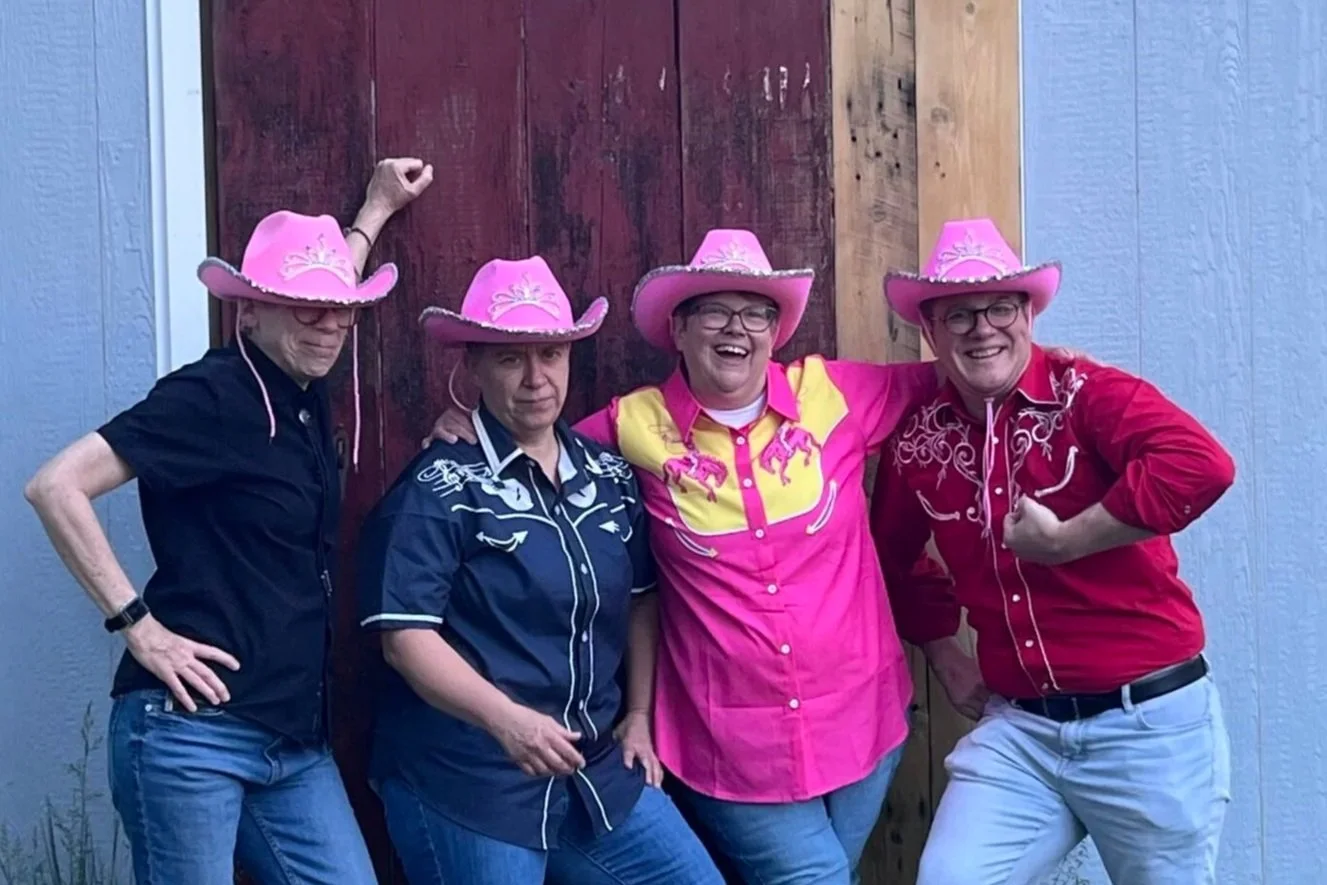
Members of Honkytonk Queertones (left to right): Tammy Bringaze, Jess Martin, Kim Hoff, and Emmett Troxel
Country music has not always felt like home for queer people. Honky Tonk Queertones — a Western Massachusetts band built on twang, harmonies, and joyful resistance — is changing that.
Formed by Jess Martin, Emmett Troxel, Kim Hoff, and Tammy Bringaze, the band grew out of a rock band class and a simple question: what happens when queer musicians with wildly different backgrounds claim country music as their own? The answer, it turns out, involves lyric flips, line dances, donations to the Trevor Project, and rooms full of people singing along at the top of their lungs.
Bloom Local sat down with all four members to talk about where Honky Tonk Queertones came from, what it means to play country music as a queer act of reclamation, and what they want you to know before you show up to a show. Boots optional.
Take me back to the moment this started feeling like more than a band.
What did that shift feel like?
Emmet: It was the moment we asked for donations for the Trevor Project and we received applause. It felt more like resistance and community than entertainment.
Tammy: Although I grew up surrounded by country music (yes Plainville, IL, pop 250 and lived in a red log cabin) I never saw myself in a country band. Jess, Emmett and I were in a rock band class together last winter and Jess asked me to try it out. I told my wife, I wasn’t terribly drawn to the music but wanted to check it out.
Kim: For me, it was immediate. I felt like we were coming together with a purpose to make not just music, but joyful resistance, and that’s just what we’ve done. Then when Tammy joined our group earlier this year, it all just felt more complete - as though we had regained a part of the band we didn’t even know we were missing.
Jess: I think it started happening before we even played our first show. Honkytonk QueerTones began as this slightly mischievous experiment: what happens if queer musicians with very different backgrounds get together and claim country music as a space for ourselves? But pretty quickly, rehearsals stopped feeling like we were simply putting together a set. We were laughing a lot, rewriting and reimagining songs, talking about what these songs meant to us and our place in country music, and thinking about how to make the audience part of what we were creating.
The 90-minute set at Luthier’s Coop in Easthampton was an ambitious goal we set for ourselves earlier in the summer. We decided to donate all of our tips that night to The Trevor Project, and when we announced that from the stage, the audience applauded. Emmett described that moment perfectly: suddenly it felt like resistance and community rather than just entertainment.
That’s when I thought, oh—people might actually need this. Maybe we do, too.
You're all coming from different musical backgrounds.
What drew each of you to country specifically, and how do those backgrounds show up in the sound?
Jess: My own musical life has always been pretty genre-fluid — I’m a singer-songwriter, but I’ve moved through folk, rock, Americana, theatrical music, and all kinds of strange creative collaborations. What I love about country is the storytelling. At its best, a country song can establish a character, break your heart, make you laugh, and give you something to sing along with in about three minutes.
And the four of us really do come at this music differently, which is part of the fun. Nobody is trying to create some perfectly polished, historically correct version of a country band. We bring our own musical histories and personalities into it. There’s classic country, contemporary country, folk, rock, humor, theatricality, harmonies, sing-alongs — and occasionally a song gets queered up a little along the way. That collision is becoming the Honkytonk QueerTones sound.
Emmet: My background in country music has been complicated because it never felt accessible to me as a queer person. So this feels like reclaiming the parts of country music that are about solidarity with the everyday person and resistance against external powers.
Tammy: Similar to what I hope others experience when they come to see us perform, I was drawn to positive energy of the group in that first rehearsal! I didn’t even know several of the songs but have found many of these newer songs (to me) are now some of my favorites.
Kim: I’ve always loved country music. Maybe it’s the twang or the musical tone. Maybe it’s the lyrics that sometimes make me laugh. It could be that one of the best times with my Dad was at a country music festival. Or perhaps the line dancing. Fun fact — in my 20s I went country line dancing with friends every Thursday night for about 2 years. Back then, I could Boot Scoot Boogie with the best of ‘em!
What I haven’t always loved is the exclusionary feeling — that being queer made me unwelcome to the club. That not only was I mostly unrepresented in the genre, but that many of the artists would not enjoy my enjoyment of the genre. That even if the songs were fun or sounded great, that I somehow couldn’t be part of singing them. Now we’ve made country into what we need country to be: fun, political, and queer!
What does it mean to sing country, made by and for queer people, in a genre that hasn't always felt open to LGBTQ+ folks?
Kim: It feels like a reclaiming. It feels like my way to resist, to be political, to stand up, to protest…and to have a damn good time doing it. The way we do this music…it makes people smile. It makes people sing. It forms community and it gives folks a way to release their frustrations with our current political situation in a positive, fun way. Joyful resistance!
Jess: For me, it feels like both reclamation and expansion.
Country music contains so many things that queer people understand intimately: longing, heartbreak, leaving home, finding home, chosen family, outsiders, resilience, desire, working-class life, resistance. Those stories already belong to us, even if the industry surrounding the music hasn’t always made queer people feel welcome.
So there’s something powerful about standing onstage and saying: we’re here, we love this music, and we don’t have to ask permission to participate in it.
But I also don't want Honkytonk QueerTones to be defined only by resistance. There is so much joy in this project. We’re creating the country dance floor we want to be on — one where queer and trans people can walk in, sing loudly, dance badly or brilliantly, laugh, bring their friends, and know that the room is theirs too.
Tell me about the line dance workshop with My Health Matters and the Flo Fest performance in September. What did you hope people would walk away with?
Kim: We didn’t want them to walk away…we wanted them to DANCE away…with a few new steps, lots of laughter, a fun time, a little exercise, and a feeling of being welcome, accepted, and heard.
Tammy: We may not be the best band that folks have ever heard, but I think we might be a contender for one of the most fun bands they have encountered!
Jess: This partnership took the idea behind Honkytonk QueerTones and got everybody out of their chairs.
The line dance workshop with My Health Matters was meant to be welcoming and low-pressure. You absolutely did not need to think of yourself as a dancer — or even as someone who likes country music — to participate. We wanted people to learn some moves, laugh together, feel comfortable in their bodies, and experience what it's like to be part of a queer country dance floor.
And then there was a wonderful payoff: the next day, Honkytonk QueerTones performed at FloFest. People who came to the workshop showed up already knowing a line dance and became part of the performance itself.
That felt especially meaningful because FloFest was making its grand return after its pandemic hiatus. There was something really beautiful about helping bring people back together through music, movement, queer community, and celebration. We don't just want to play at people — we want to create something with them.
For someone who's never listened to country, or never felt invited into it, what do you want them to know before they come to a show?
KIM: Expect the unexpected. This is country like you’ve never heard before and have maybe never imagined. Come ready to listen to the lyrics and ready to laugh. Come ready to hear new perspective. Come ready for goosebumps now and then. And maybe even a little yodeling.
Jess: You don't need to know anything. You don't need boots. You don't need a cowboy hat. You don't need to know the songs. You don't need to know how to line dance. And you definitely don't need anyone's permission to be there.
Come because you like live music. Come because you're curious. Come because you want to dance. Come because you want to hear a room full of people sing together. Come because maybe country music has never felt like it was meant for you.
We're trying to build a honky-tonk where the invitation is simple: there's room for you on this dance floor.